




Debt settlement companies technically aren’t allowed to charge fees until after lowering a consumer’s debt. But a loophole in the Telemarketing Sales Rule — and a mish-mash of federal and state laws — allows predatory firms the opportunity for exploitation.
A growing corner of the $23 billion debt relief industry has used a workaround regulators have dubbed the “attorney model” — taking money to the tune of tens of millions of dollars from consumers, according to Consumer Financial Protection Bureau actions since 2010. In this scheme, settlement companies masquerade as law firms, sometimes “renting out” a law license — since lawyers are allowed to collect advance fees, this provides a nifty if questionable way for these companies to cash in before doing any work. More often than not, however, these companies don’t actually connect consumers with attorneys.
Debt settlement is meant to fast track getting you out of the red when you’re in debt. Instead of walking away with less debt, consumers who fall prey to the attorney model can end up with ruined credit and money spent out of pocket. That’s what happened to Coya Davis, a 31-year-old ex-project manager in Atlanta.
Davis was almost $27,000 in credit card debt when she learned about the Clear Creek Legal Debt Resolution Program in November 2023. After enrolling, Davis received a welcome email from the company telling her she’d made a smart choice and, with its help, would have her debts negotiated, settled and resolved for a fraction of what she owed.
As is common practice, Clear Creek instructed Davis to stop paying her creditors and redirect her monthly payments into a trust account that could be later used for a settlement. It was the solution Davis thought she was looking for.
“My minimum payments felt too high,” she says of her debt. “I wanted something that streamlined everything, maybe even a lump-sum option.
While you can “DIY” debt settlement, hiring a reputable debt settlement company to negotiate your balances can be helpful when you’re juggling multiple creditors, interest rates and payment schedules. Though some firms can help consumers get out of debt sooner, others see financial anxiety as a means to line their own pockets. That’s what happened to Davis: When she left Clear Creek’s program, her debt was no lower than when she enrolled and her credit score had gone from the 700s to the 400s, she says. Davis was also out nearly $500, despite the clear Federal Trade Commission and CFPB rules that prohibit these companies from charging upfront fees.
The size of the debt settlement industry waxes and wanes, but it historically rebounds in high periods of financial stress. Although it currently remains below Great Recession levels, the U.S.-led global debt settlement market is expected to expand from $4.8 billion in 2024 to $7.2 billion by 2032, according to Credence Research, even though we’re not in a recession.
For Davis, her debt was a result of losing one of her two jobs. With her income slashed in half, the bills began to pile up. “I felt overwhelmed,” she says.
Debt settlement’s legal loophole
If you hire a debt settlement firm, you’re responsible for paying their fee once your account is settled — it’s usually between 15% and 25% of the total debt you bring into the program. Enroll $50,000 in debt, and what you owe the settlement company can range from $7,500 to $12,500.
However, federal law limits when in the process those debt settlement companies can charge those fees. The Telemarketing Sales Rule, Consumer Financial Protection Act and state laws all work in tandem to ensure settlement companies aren’t charging consumers until they’ve delivered actual results.
When Davis wanted to quit Clear Creek’s program — she couldn’t get straight answers about when her debt would be paid off, and she began to suspect she was being ripped off — she wanted all of her money back. She’d paid nearly $1,500 over three months. Clear Creek only returned $1,000, claiming it needed the rest to cover her account setup fees.
“It made no sense because the money was supposed to be in a pot they’d later use to pay creditors,” says Davis. “But at that point, I chalked it up as a loss.”
Clear Creek Legal Debt Resolution Program, whose website went dark in January 2026, had leveraged the loophole of acting as a law firm to charge upfront fees. The company did not respond to Bankrate’s multiple calls and emails when its contact information was publicly available online.
“Some companies work through law firms in name only,” says Martin Lynch, president of the Financial Counseling Association of America (FCAA). “The settlement company still does all the work; there’s no real legal representation. It’s just a way to skirt FTC rules and get to the fees as quickly as possible, because they know the consumer’s finances are fragile.”
Whenever Davis called Clear Creek, she never got the impression she was speaking to a lawyer.
“They were just a regular customer service agent, someone there to answer general questions,” she tells Bankrate.
Andrew Pizor, senior attorney at the National Consumer Law Center, says he’s even seen larger debt settlement companies outsource their customer service to other countries.
“The people actually doing the work on consumers’ accounts are virtually never attorneys,” he says. “The only attorneys involved are basically just lending their names to a letterhead.” Pizor says the practice is called fronting your license. “They’re doing it to exploit the loophole,” he adds.
The only time Davis felt she was working with a legal entity was right after she enrolled, when Clear Creek sent a notary to her home to complete power of attorney paperwork, a routine part of the debt settlement process. Despite the word “attorney,” the documents don’t require a lawyer. (Granting a debt settlement company power of attorney simply allows it to communicate or negotiate with creditors on a consumer’s behalf.)
Had Davis worked with a lawyer employed by Clear Creek, she could have gotten better advice. She might have been told, for example, that successful debt settlement typically involves being delinquent on your payments. Davis wasn’t behind on her accounts and didn’t realize that lessened her leverage in the settlement process. Clear Creek welcomed her with open arms anyway.
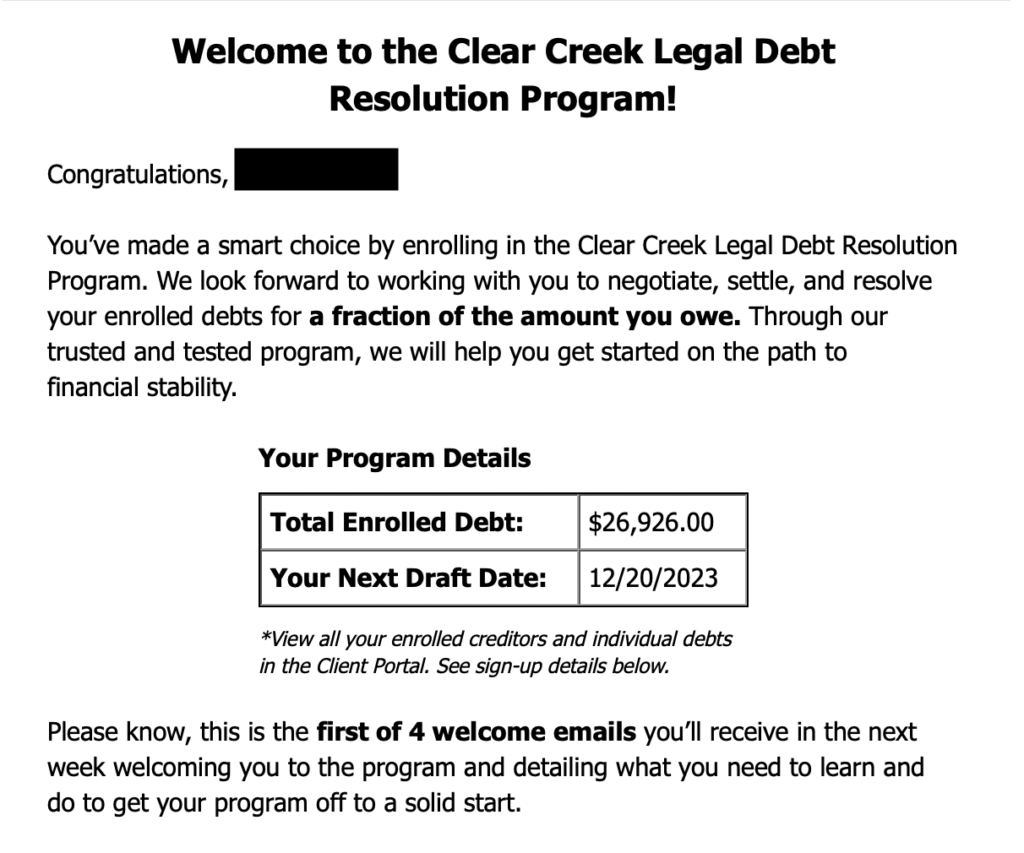
When Davis reflects on her poor fit for Clear Creek’s services, she says it “pisses [her] off.” She faced one of the consequences of debt settlement — major damage to her credit — without the promised upside of actually lowering her debt. That, and she paid almost $500 to do it.
“Falling behind on payments incurs credit score damage and late fees,” adds Bankrate analyst Ted Rossman. “The typical tactic is to stop paying for a while and try to use that as leverage to settle for less than what you owe, but it trashes your credit.”
Your debt settlement lawyer might not be there when you need them most
“I’ve seen people at the courthouse very confused because they thought they were working with an attorney who would be there to represent them in court,” says Carolyn Lander, a staff attorney at the nonprofit Legal Services of Long Island. “They’ll tell me they’ve been paying a debt settlement company and don’t understand why they’re being sued.”
The rise of the ‘attorney model’
The attorney model was largely pioneered by Morgan Drexen and Legal Helpers Debt Resolution in 2007. Morgan Drexen’s president and chief executive officer, Walter Ledda, was sued by the CFPB in 2013 for charging illegal upfront fees and misrepresenting its services to consumers. The CFPB complaint was resolved in 2016 after Morgan Drexen was ordered to pay nearly $132 million in restitution and a $40 million civil penalty.
Far from killing the attorney model, the Morgan Drexen case provided a blueprint for its evolution. A decade later, Strategic Financial Solutions would refine the scheme to an even larger scale.
In January 2024, the CFPB and seven state attorneys general filed a civil complaint against Strategic Financial Solutions alleging they operated a large-scale, deceptive debt relief scheme. In the complaint, the CFPB and state regulators accused SFS of allegedly enticing borrowers with misleading claims of legal aid or personal loans, only to steer them into debt relief programs that charged thousands of consumers more than $100 million in illegal upfront fees. In many cases, the lawsuit also alleges that no debt settlement ever occurred. (SFS was helmed by Ryan Sasson, the stepson of Stephen Drescher — who some might remember as the character Jonah Hill portrayed in Martin Scorsese’s 2013 film The Wolf of Wall Street, according to the New York Times.)
Running a company with dozens of subsidiary shell companies and bogus law firms isn’t how a legitimate business operates, says Lynch.
“That’s a structure designed from day one to rip people off,” he adds. Pizor agrees, claiming that these companies exploit people who think they’re getting genuine legal representation. “If you’re calling up a debt settlement company, chances are, you’re not doing well financially. You’re already stressed out and vulnerable, and these companies take advantage of that,” he says.
The CFPB complaint against SFS listed 29 corporate defendants and 17 “facade” law firms in the body of the complaint. Clear Creek — the firm Coya Davis used — wasn’t named as a defendant in the initial complaint, but appeared as one of 24 such firms in the amended complaint. Bankrate reached out to 18 of those 24 law firms named with publicly available contact information but did not receive comment.
SFS argued in court that its advance-fee practices fell under an exemption in the Telemarketing Sales Rule for “face-to-face sales presentations,” a position the government and courts have rejected. The Telemarketing Sales Rule allows upfront fees only after a genuine face-to-face sales presentation, but courts ruled that SFS’s use of notaries to finalize paperwork didn’t qualify because the sales pitch itself occurred remotely. In filings, SFS also asked the court to stay the preliminary injunction pending appeal, seeking to pause enforcement of the CFPB’s order while it challenges the legal claims against it. The company’s appeals were rejected and now, its assets are under the strict supervision of a court-appointed receiver.
In November 2025, SFS filed a motion to dismiss the case. If granted, the CFPB and attorneys general would effectively be back at square one.
Without regulatory oversight, relief scams can ‘find a workaround’
The complaint against Strategic Financial Solutions is the prominent example of the attorney model, but it’s far from the only one.
In 2024, consumers filed north of 34,000 complaints with the FTC against shoddy mortgage foreclosure relief and debt management companies. In total, consumers lost more than $82 million. Keep in mind, that’s just what was reported.
The problem is, predatory settlement companies often move faster than the law can keep up with. That’s why the debt settlement legal loophole, built by the so-called attorney model, hasn’t completely closed.
“If they can’t do one thing, they find a workaround,” says longtime financial counselor Todd Christensen.
The regulatory environment is already loosened, thanks to President Trump’s “One Big Beautiful Bill Act,” which hobbled CFPB borrowing power when it was signed into law in July 2025. The Trump Administration has also announced plans to cut tens of millions from the FTC’s budget, including an $18 million reduction to its Bureau of Consumer Protection.
The Trump administration has faced some pushback for weakening consumer protection agencies. In the NTEU v. Vought lawsuit, the CFPB employees’ union is challenging whether the Trump administration has the legal authority to shut down a congressionally established agency without first passing new legislation that updates the law that created it. If the courts side with the administration, it would effectively grant the executive branch a green light to finish dismantling the CFPB from within.
With federal oversight cut off at its knees, it’s up to the state attorneys general to keep debt settlement companies in check. But the process of doing so is tricky when settlement regulations vary widely across states and there are attorneys involved. Put simply, it takes a lot to get a state to take a complaint about an attorney’s office seriously.
“State regulators can have a really narrow focus,” says the NCLC’s Pizor. “You really have to commit malpractice or steal from a client, or not respond to a client’s phone calls to really trigger an investigation.”
Pizor rarely sees regulators going after lawyers running scammy debt settlement companies. “I think it’s a shame,” he adds.
Currently, the Telemarketing Sales Rule requires debt settlement companies to self-report their own practices, which leaves additional room for bad actors to maneuver, especially at scale.
“You need regulators pulling random cases and seeing how they really went,” the FCCA’s Lynch says.
Consider your debt relief options with a discerning eye
While not every debt relief company or option is out to scam consumers, the bad apples run the risk of spoiling the industry. Bankrate interviewed two executives at reputable debt settlement companies who regret the toll that scams have played on its well-meaning goal, to help consumers strategically get out of debt. And sometimes, it actually works: companies resolved more than $2.8 billion in unsecured consumer debt in 2022, covering more than 1.2 million individual accounts, according to the American Association for Debt Resolution.
And yet, being able to pick out the bad apples is critical to avoiding the fate of people like Davis.
How to spot a bad debt settlement company
Settlement isn’t always a good idea. But for those considering it, Bankrate asked experts on both sides of the aisle — nonprofit credit counselors and those in the for-profit settlement industry — for some red flags to be mindful of when choosing a company. Here’s what to watch out for:
-
- Upfront fees: No debt settlement company should charge you fees until your debt has been settled. You only owe a settlement company money after a settlement agreement has been reached.
- Unclear timelines: A reputable settlement company will walk you through how long the process takes from start to finish.
- Guaranteed outcomes: Companies that advertise guaranteed savings or debt reductions should raise suspicion — there’s no guarantee that your creditors will agree to settle.
- Failure to disclose the risks: A good debt settlement company will walk you through the tax, credit and other implications of settling a debt before you enroll.
- Pushy sales tactics: Reputable debt settlement companies don’t pressure consumers with aggressive sales tactics, artificial deadlines or repeated follow-ups to force a quick decision.
- Unsolicited outreach: A debt settlement company should not reach out to you — online, by phone, mail or otherwise — to get you to sign up. Reputable companies wait for individuals to seek help on their own, according to National Debt Relief executive Natalia Brown.
- Offering secured debt settlement options: Only unsecured debts, such as credit card bills, phone bills and medical debts, can be settled. Secured debts, like those tied to a seizable asset like a car or house, aren’t eligible for settlement.
- False authority claims: Some settlement companies use official-sounding programs to advertise. “One I’ve been hearing more is ‘Did you know that President So-and-So recently signed a bill saying you don’t have to pay your credit card debts back?’” says Christensen. “Anytime you hear a pitch like that, avoid that company like the plague.”
- No accreditation: Debt settlement companies should be accepted by the Association for Consumer Debt Relief (ACDR), an industry association, says Brown. It can also be helpful to see if a company is accredited by the Better Business Bureau.
For Davis, one bad experience with debt settlement was more than enough to turn her off of it completely. After she walked away from Clear Creek, her bank recommended Money Management International (MMI), a nonprofit credit counseling agency, and its debt management plan (DMP).
With a DMP, you’re still paying your creditors, but through a credit counseling agency and at reduced interest rates and late fees. The reduced interest means most of Davis’s $386 bimonthly payments goes to principal, not interest.
Plus, Davis’s credit score is back on the rise, even if she’s paying fees — legitimate fees this time around.
What to know about DMP fees
Unlike settlement, you pay upfront fees on a debt management plan. However, those fees are state-regulated and are typically below those charged by a settlement company. MMI’s average monthly processing payment is $27, and the agency charges an average of $38 to set up an account, according to Tara Alderete, a director at MMI.
A debt management plan is also a slower process than settlement, tracked in years rather than months. When Davis first signed up in 2023, MMI predicted she’d complete the program by August 2028.
“I’ve already knocked that to January 2028, and with a few more accounts paid off, I might even finish in mid-2027,” says Davis. She adds: “It feels good to work with a company that’s actually helping me instead of hurting me, and to see real progress.”
Why we ask for feedback
Your feedback helps us improve our content and services. It takes less than a minute to
complete.
Your responses are anonymous and will only be used for improving our website.
Help us improve our content
Read the full article here